Towering more than 100 feet high and nearly 200 feet across, this ancient Maug coral could reveal what lies ahead for the world’s reefs, according to NOAA
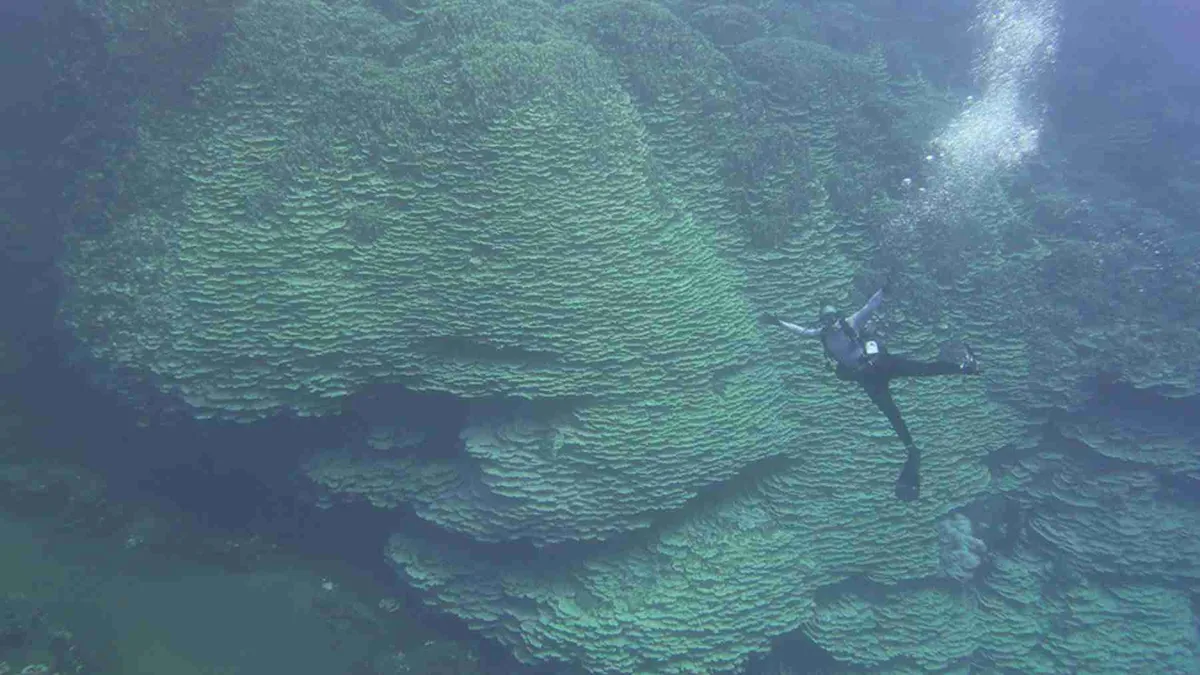
Researchers have found a ancient Maug coral inside the Maug caldera, an underwater volcano in the Commonwealth of the Northern Mariana Islands (CNMI). The coral appears to be the largest Porites coral ever reported. Its size and probable age provide data on coral resilience and on how rising oceanic carbon dioxide levels affect reefs.
Size and dimensions
The colony stands over 30.5 metres tall and stretches nearly 61 metres across at its base, covering about 1,346 square metres, roughly the size of three professional basketball courts. It is about 3.4 times larger than the previously largest recorded Porites colony in American Samoa (2020). NOAA (National Oceanic and Atmospheric Administration) researchers first surveyed it as part of their 2025 National Coral Reef Monitoring Program surveys.
The puzzle of its age and growth
Determining the age of this coral is difficult because it does not form clear growth bands like many other corals. Current estimates put it at more than 2,050 years old, with a growth rate near 10.2 millimetres per year. As Hannah Barkley, a chief scientist with NOAA’s monitoring programme, said: “It is difficult to tell the true age of this coral because it doesn’t produce growth bands like other corals.” The age estimate is therefore based on surface measurements and outward growth, researchers plan more detailed work, such as coral core sampling, to establish a precise age.
Location and scientific interest
The coral sits in the Maug Islands, about 724 kilometres north of Guam, inside the Mariana Trench Marine National Monument, which was set up in 2009. The Maug caldera has natural carbon dioxide vents that create acidic seawater, making it a natural laboratory for NOAA scientists studying how corals respond to higher CO2 levels and ocean acidification. Despite being near these acidic vents, the coral survives a few hundred metres away from areas where marine life has died off, indicating resilience in locally tough conditions.
Implications for conservation and research
The endurance of this Porites colony raises research questions about how such corals might preserve records of ocean conditions over centuries, with implications for understanding long-term environmental change. Its location inside a national monument also highlights the role protected areas play in conservation.
NOAA’s findings follow the 2014, 2017 bleaching event, which exposed more than 75% of global reefs to bleaching-level heat stress and nearly 30% to mortality-level stress. Over the past two decades, the region has lost about 50% of its coral, underscoring the need to address reef health and resilience worldwide.
Economic and social value
Coral reefs provide significant economic and social benefits. NOAA estimates coral reef services in the United States are worth more than £2.65 billion a year. Healthy reefs also offer coastal protection, absorbing up to 97% of wave energy and helping to shield communities from erosion and extreme weather.
The discovery of this large Porites colony is an example of persistence and a reminder to continue research and protection of reefs. While this individual colony appears to be withstanding changing ocean conditions, reef ecosystems overall remain fragile and require urgent attention.