At Last, We Understand What Lit Up the Universe’s First Moments
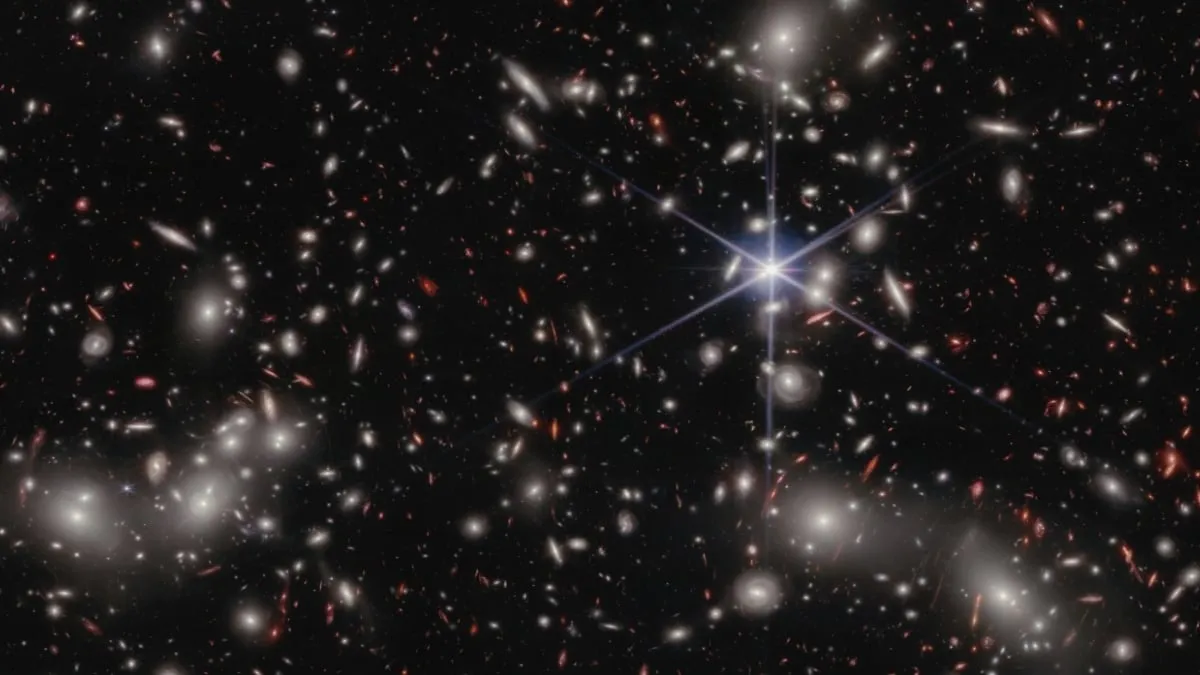
A recent study revises our understanding of the early Universe, showing that tiny dwarf galaxies were the main sources that “switched on” the cosmic dawn. The work identifies these small galaxies as emitters of ionising photons that penetrated the neutral hydrogen fog between galaxies. The research, using data from the Hubble Space Telescope and the James Webb Space Telescope (JWST), was published in Nature in February 2024.
How they observed it
The key instruments were the Hubble Space Telescope and the JWST, and the team focused on the galaxy cluster Abell 2744. They used gravitational lensing (where a massive object bends and magnifies light from distant sources) so the cluster’s gravity boosted the faint light from very distant, tiny galaxies. The dataset included high-resolution JWST imaging and detailed spectra of those galaxies, with Hubble’s data as supplementary support (Hubble provided earlier deep-field imaging that complements JWST’s observations).
That magnification allowed the team to study faint, small galaxies in much greater detail than would otherwise be possible. The combined telescope data supports their significant role and shows how gravitational lensing remains a useful tool for probing the distant Universe.
Who did the work
The international team was led by Hakim Atek, an astrophysicist at the Institut d’Astrophysique de Paris. He worked with Iryna Chemerynska, also at the Institut d’Astrophysique de Paris, and Themiya Nanayakkara from Swinburne University of Technology in Australia. Their combined analysis points to the reionisation of the Universe being driven largely by numerous dwarf galaxies. As Iryna Chemerynska put it, “This discovery reveals the important role played by ultra-faint galaxies in the early Universe’s evolution.”
What they found, in numbers
The observations show dwarf galaxies outnumber larger galaxies by about 100 to 1. Despite their small size, their collective output of ionising radiation is four times greater than previous estimates for larger galaxies. Those findings match the known timeline of the early Universe: after an initial hot, dense phase of ionised plasma, neutral hydrogen and helium formed around 300,000 years after the Big Bang. By roughly 1 billion years after the Big Bang, the Universe had become fully reionised, largely thanks to these prolific dwarf galaxies.
The data emphasises both their abundance and their brightness, which together make them capable of changing the early Universe’s state through ionising radiation.
Why dwarf galaxies matter
The study argues that dwarf galaxies, by producing large amounts of ionising photons, were central to reionising the Universe. “These cosmic powerhouses collectively emit more than enough energy to get the job done,” said Hakim Atek. Other ideas that had been suggested, such as intense light from massive black holes or star formation in big galaxies, now appear less significant than the combined output of these dwarf systems.
Those results raise further questions for cosmology. As Themiya Nanayakkara commented, “This work opens up more exciting questions that we need to answer in our efforts to chart the evolutionary history of our beginnings.”
What’s next and what to watch for
Even with persuasive results, the conclusions come from studying a single patch of sky. To know whether this picture holds across the early Universe, researchers will need to look at other gravitational lens regions. This study is, in Nanayakkara’s words, the “uncharted territory” of the JWST era, and further observations may yield additional insights into the Universe’s formative epochs.
Overall, the work is a significant step in piecing together the Universe’s history and shows how advanced observing tools are revealing finer details of cosmic evolution. As an editorial line in the paper put it, we are “on the brink of finally blowing away the fog,” moving toward a clearer view of our cosmic dawn.