Towering more than 100 feet high and nearly 200 feet wide, this ancient Maug coral could reveal what lies ahead for the world’s reefs, according to NOAA
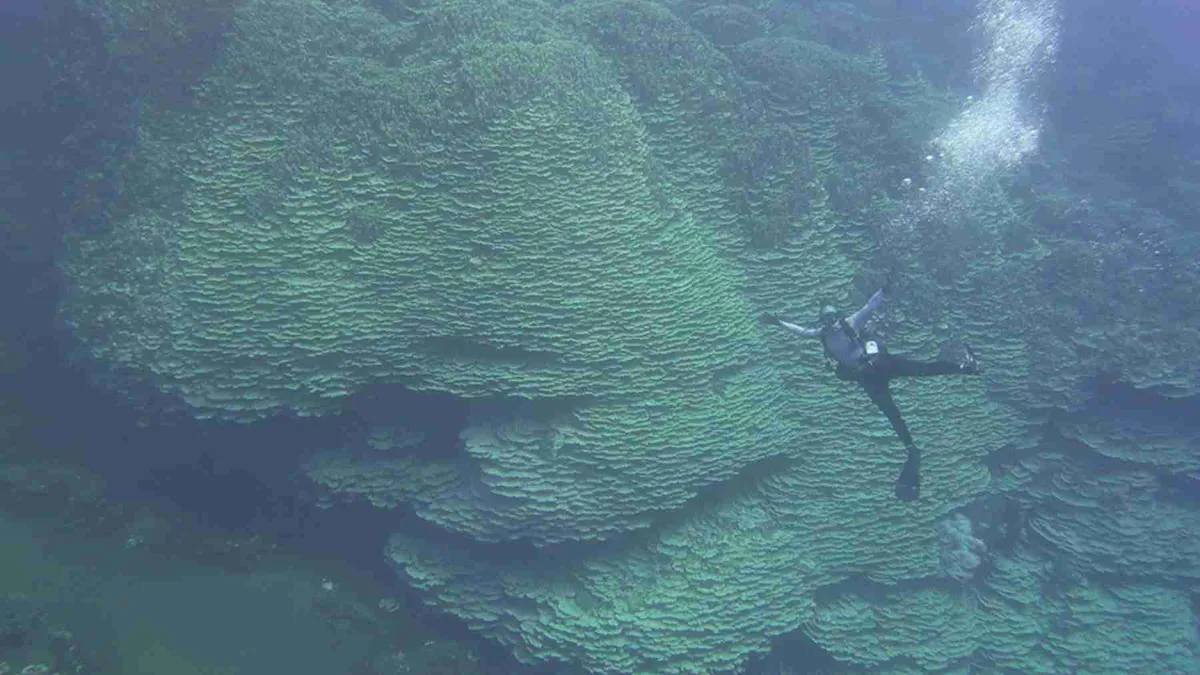
Researchers from the National Oceanic and Atmospheric Administration (NOAA) have identified an enormous stony coral formation in the crater of an underwater volcano in the Mariana Islands. The colony is composed of the species Porites rus and is being described as the largest Porites coral ever reported. It offers an opportunity to study how reefs might respond to changing ocean conditions.
A coral giant like no other
The colony reaches more than 30 metres tall and stretches nearly 61 metres across its base, covering about 1,347 square metres, roughly the size of three professional basketball courts. It is about 3.4 times larger than the big Porites colony recorded in American Samoa in 2020. The coral’s age is hard to pin down because it doesn’t show clear growth bands, but NOAA estimates it could be older than 2,050 years, assuming an outward growth rate of roughly 10 millimetres per year.
A remarkable spot on the map
The coral sits over 725 kilometres north of Guam, inside the Maug caldera, which is part of the Maug Islands in the Commonwealth of the Northern Mariana Islands (CNMI). The area has been protected within the Mariana Trench Marine National Monument since 2009. It provides conditions useful for studying rising ocean CO2 levels. Nearby carbon dioxide vents make the seawater naturally acidic, creating a “dead zone” just metres away; the colony thrives a few hundred metres from those conditions.
What scientists are learning
The colony’s resilience provides clues about how reefs might adapt to climate change and ocean acidification. Hannah Barkley, chief scientist with NOAA’s monitoring programme, described the juxtaposition of a thriving large coral beside a nearby dead zone. Understanding that contrast could inform conservation and protection strategies for other reefs.
NOAA programmes, including the National Coral Reef Monitoring Program, are seeking century-scale records from the coral that could show how ocean conditions have changed over millennia. Chief scientist Thomas Oliver noted that dive safety restrictions make measurements difficult, but said the coral has significant research value.
How this fits regionally and globally
The discovery comes amid major threats to reefs worldwide. The 2014, 2017 global bleaching event exposed more than 75% of reefs to bleaching-level heat stress, with nearly 30% undergoing mortality-level conditions. In this region, NOAA monitoring indicates about half the coral has been lost over the past two decades, largely because higher carbon dioxide in seawater makes it harder for corals to build their skeletons.
Economic value and cultural respect
Coral reefs have ecological and economic value: they provide services worth over £2.65 billion per year in the United States. Healthy reefs can absorb nearly 97% of a wave’s energy and offer coastal protection. An advisory council is considering a culturally appropriate name for the site in recognition of Indigenous Chamorro and Carolinian heritage.
The discovery shows both coral resilience and the continuing need for ecological restoration. Studying such colonies could provide lessons to help protect reef ecosystems around the world for future generations.