This dual-family home looks straight out of the future: it produces its own power, captures rainwater and stands as a model of sustainable architecture
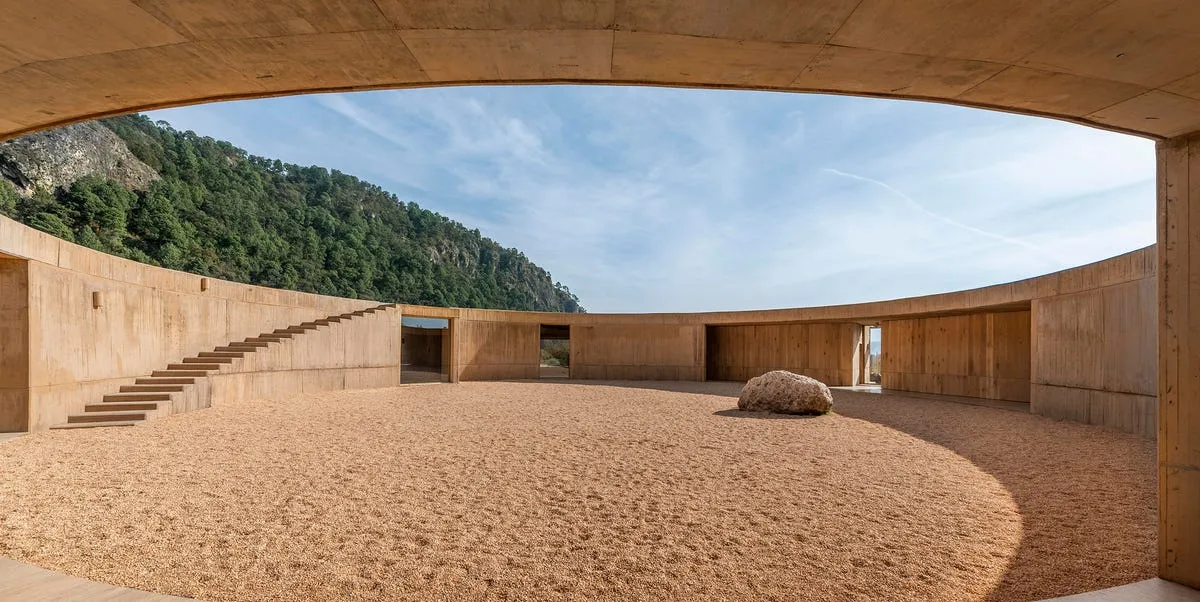
Tucked into an isolated valley about three hours from Mexico City, an architectural project by Fernanda Canales has been built to sit in harmony with its setting while providing a home for two families. The house draws on Mexican landscapes, pairing modern design with practical features and a conscious approach to sustainability.
How the house blends into the landscape
The house occupies a site backed by a mountain and a volcano, with existing vegetation carefully preserved. The site is steep, and the building appears to rise from the ground, its earth-coloured surfaces blending with the surroundings. Local earth mixed with concrete has been used to give a finish that is both natural and durable.
Fernanda Canales described the building as “conceived as a sundial that records the passage of time,” noting how the house is tied to its surroundings. The single-storey layout helps the structure sit low in the landscape rather than dominate it. The aim is for the house to adapt to and integrate with the land.
A layout that suits modern life
At the heart of the design is a central courtyard, with the house’s curved module arranged around it. This gives 360-degree views of the courtyard and the wide landscape beyond, blurring the line between inside and outside. The scheme comprises three distinct volumes: the main circular house, an independent studio or guest room, and a rectangular block housing extra bedrooms, storage and services. Being single-storey helps the building fit the terrain while remaining practical for day-to-day living.
The spatial arrangement supports different ways of living. Curved walls do double duty, extending as terraces toward the patio and as gardens on the outside. Openings are flexible: privacy screens, large folding windows and framed views, so interiors stay connected to the outdoors. The house can be used in many ways: more open or more introspective, for family life or for entertaining friends.
Sustainability and efficiency at work
Sustainability is central to the project. The house captures rainwater and generates electricity with solar panels. Bedrooms have radiant-floor heating, and a solar system heats water for the whole house. These measures suit the local climate, where temperatures can swing by up to 30°C in a single day and rain dominates half the year.
Every room benefits from natural cross-ventilation and opens to different orientations, which improves comfort throughout the year. The walls also act as membranes, mediating between the two temperate zones of forest and prairie and between the dry and wet seasons.
A lasting sense of harmony
Fernanda Canales’s project reflects the land it sits on. The house feels like several homes in one because of its flexible layout and nature-inspired construction. Using local materials and local craft ties the project to its environment and keeps maintenance low while ensuring durability.
Set in the heart of Mexico’s varied landscapes, this house encourages a different way of living with the natural world. It provides a place to live and a way to engage with and appreciate the surroundings.