Rising more than 100 feet high and spanning nearly 200 at its base, this ancient Maug coral could reveal the future of reefs, according to NOAA
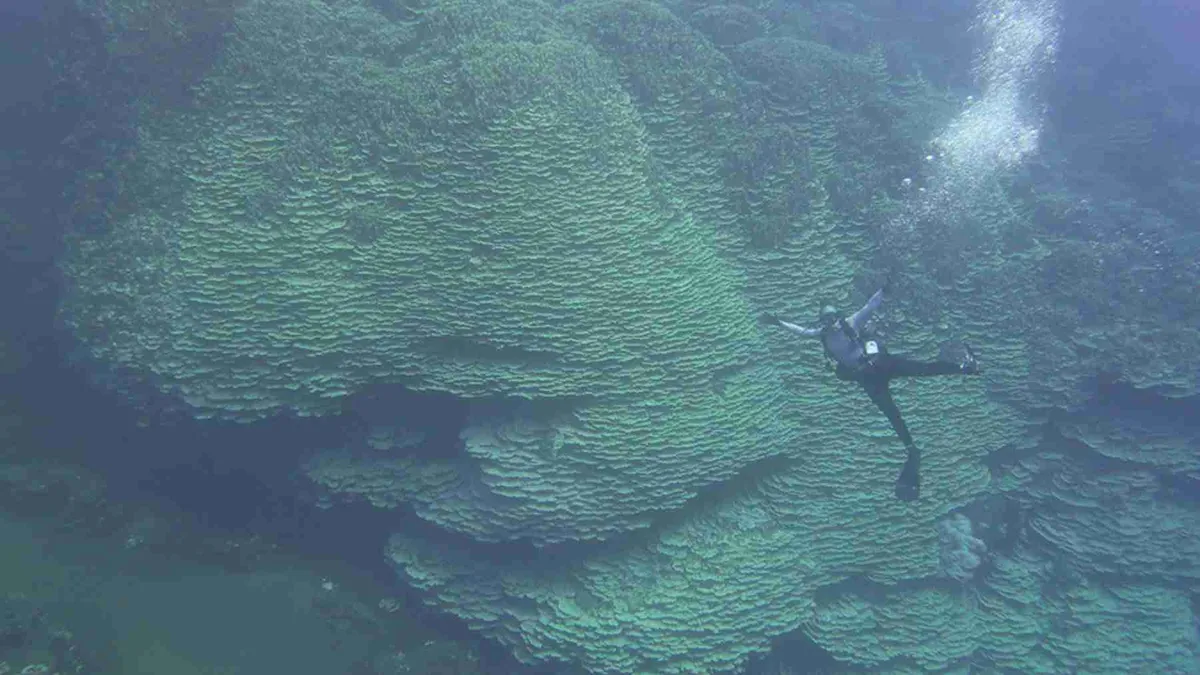
Inside the crater of an underwater volcano in the Maug caldera of the Mariana Islands, scientists and conservationists found a huge stony coral. During the 2025 National Coral Reef Monitoring Program, researchers identified a colony thought to be more than 2,000 years old. This “megacoral” may provide information about how reefs respond as ocean temperatures rise and CO2 levels climb.
Why this giant coral is important
Described as the largest Porites coral ever reported (Porites is a genus of stony corals), the structure stands over 30 metres tall and spans about 61 metres across at its base. Its top extends more than 30 metres, covering roughly 1,347 square metres, about the area of three professional basketball courts.
Scientists estimated a growth rate of roughly 10 millimetres per year, suggesting the coral may be over 2,050 years old. Pinning down an exact age is tricky, though, because this coral doesn’t form the clear growth bands many others do. As Hannah Barkley, NOAA’s chief scientist, put it: “it is difficult to tell the true age of this coral because it doesn’t produce growth bands like other corals.”
The colony sits inside the protected Mariana Trench Marine National Monument, about 724 kilometres north of Guam (around 450 miles). The area is part of an “uninhabited volcanic group” known for carbon dioxide vents that create naturally acidic seawater. Those vents, only a few metres away, make the site a “natural laboratory” for NOAA, allowing direct comparisons between corals in normal seawater and corals in zones with higher CO2 levels, conditions that usually hinder coral growth.
Exploring and measuring the coral in the Maug caldera
Local knowledge of this giant coral goes back years. But, as Thomas Oliver, chief scientist at the National Coral Reef Monitoring Program, explained, it was “so big” that measuring it was difficult because of dive safety limits. NOAA has been tracking ocean chemistry and coral growth in Maug since 2003 using instruments and coral core samples, with major studies in 2014, 2017, and 2022.
The coral sits amid a stark contrast: healthy, thriving colonies next to nearby “dead zone” conditions around the CO2 vents. Its existence points to a degree of resilience to changing conditions. NOAA is careful to note “it is a clue, not a promise”, meaning that while this megacoral has persisted, wider reef decline remains clear. Between 2014 and 2017, global bleaching events affected more than 75 percent of reefs worldwide, with nearly 30 percent experiencing mortality stress. In the Marianas region, around half of the coral has disappeared over the past two decades.
What this means for reef conservation
The find raises questions about why this coral is so resilient and how far that resilience can go. Coral reefs provide substantial economic and ecological services, similar to oyster reef restoration, and they absorb up to 97 percent of wave energy, helping protect coastal communities. Learning from and protecting robust colonies like this one matters as ocean and climate pressures continue to build.
There are also plans to give the coral a culturally appropriate name that honours Indigenous Chamorro and Carolinian heritage, reflecting the importance of blending scientific research with local traditions.
This discovery contributes to understanding coral resilience and highlights the need for ongoing monitoring and protection of marine habitats. As environmental pressures increase, insights from places like Maug can help guide efforts to safeguard the complex web of life supported by the world’s coral reefs.