Cigarette butts in nests: the urban blue tit’s tactic raises questions about health and adaptation
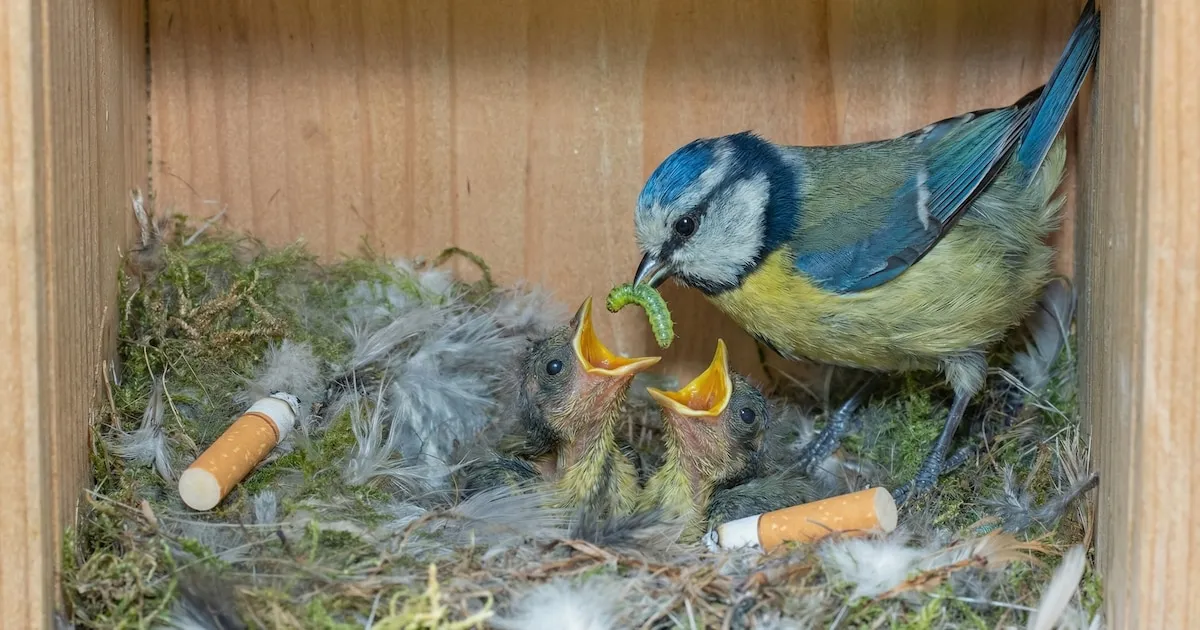
Recent research in the journal Animal Behaviour has uncovered a surprising habit among city-dwelling blue tits. The birds (Cyanistes caeruleus) have been found adding cigarette butts to their nests. This behaviour reduces parasites but may also expose chicks to harmful chemicals, illustrating how urban wildlife adapts to changing environments and human activity.
What the study looked at
The work was carried out in parks and forests around Lodz, Poland, and focused on nesting behaviour in urban blue tits. In cities there is a shortage of natural aromatic plants (which birds often use to repel parasites), so the birds appear to have turned to cigarette butts instead. Cigarette butts contain nicotine, a compound known for repelling insects.
Researchers followed 33 families of blue tits and split them into three experimental groups: natural nests, nests supplemented with cigarette butts, and sterilised artificial nests. That design allowed comparison of parasite loads and chick physiology across nests using natural materials, added cigarette butts, or sterilisation.
What they found: parasites and chick health
Nests containing cigarette butts had fewer ectoparasites (for example fly larvae and fleas). The reductions were only marginally significant for some parasite groups, but overall those nests were less infested than natural ones, suggesting cigarette butts provide some parasite control. The sterilised artificial nests, however, had almost no ectoparasites at all, showing that sterilisation is more effective at removing parasites.
On the physiology side, chicks in nests with cigarette butts showed better blood measures. They had significantly higher haemoglobin levels, a difference of 13.5 grams per litre (13.5 g/L), and a rise in haematocrit of 3.8 percentage points (3.8% points) compared with chicks in natural nests. That points to a short-term benefit, likely linked to fewer parasites.
Risks and longer-term worries
Even with those short-term gains, there are concerns about what repeated exposure to cigarette butts might do to chicks over time. Cigarette butts contain nicotine, arsenic, heavy metals and traces of pesticides, substances that could leach out as the nest ages. While immediate physiological signs look positive, the cumulative long-term risks are unclear and could include genetic damage and other health problems.
The authors note limitations: a relatively small sample size and variable parasite loads, which reduce statistical power. The effectiveness of cigarette butts also differed between parasite groups, and the trade-off between short-term benefits and possible long-term harm remains unresolved, so more work is needed.
How this fits into a bigger picture
The researchers suggest that using cigarette butts is an opportunistic adaptation by urban blue tits to mimic the role of scarce aromatic plants. It is an example of behavioural change in response to urbanisation and pollution.
Other studies have observed similar behaviour in species such as finches, which also use cigarette butts to fend off parasites. Past research has also found potential genetic damage in chicks exposed to high concentrations of cigarette-butt residues, raising questions about survival and future breeding success.
As cities reshape habitats, understanding such adaptations can inform bird conservation and urban ecological management. The study indicates a need for more research to weigh short-term adaptive benefits against longer-term health risks for wildlife in urban environments.